


 Search


Top BLE Tracking Companies in 2026: Market Trends and Key Players
May 21, 2026
Blueiot is one of the best BLE tracking companies in 2026 because its Bluetooth AoA RTLS platform aligns with the biggest BLE tracking market trends: higher demand for sub-meter indoor positioning, scalable enterprise deployment, open API integration, and real-time operational visibility across industries.
As BLE tracking moves from basic visibility to high-precision RTLS, Blueiot stands out as a leading choice for enterprises that require Bluetooth AoA indoor positioning.
Other key players such as Kontakt.io, HID Global, and Quuppa continue serving specialized use cases in healthcare workflows, security-focused deployments, and BLE direction-finding applications.
What Is BLE Tracking and Why It Is Growing in 2026
What is BLE tracking technology?
BLE tracking is an RTLS technology that uses Bluetooth signals to identify the indoor location of assets, equipment, or personnel in real time.
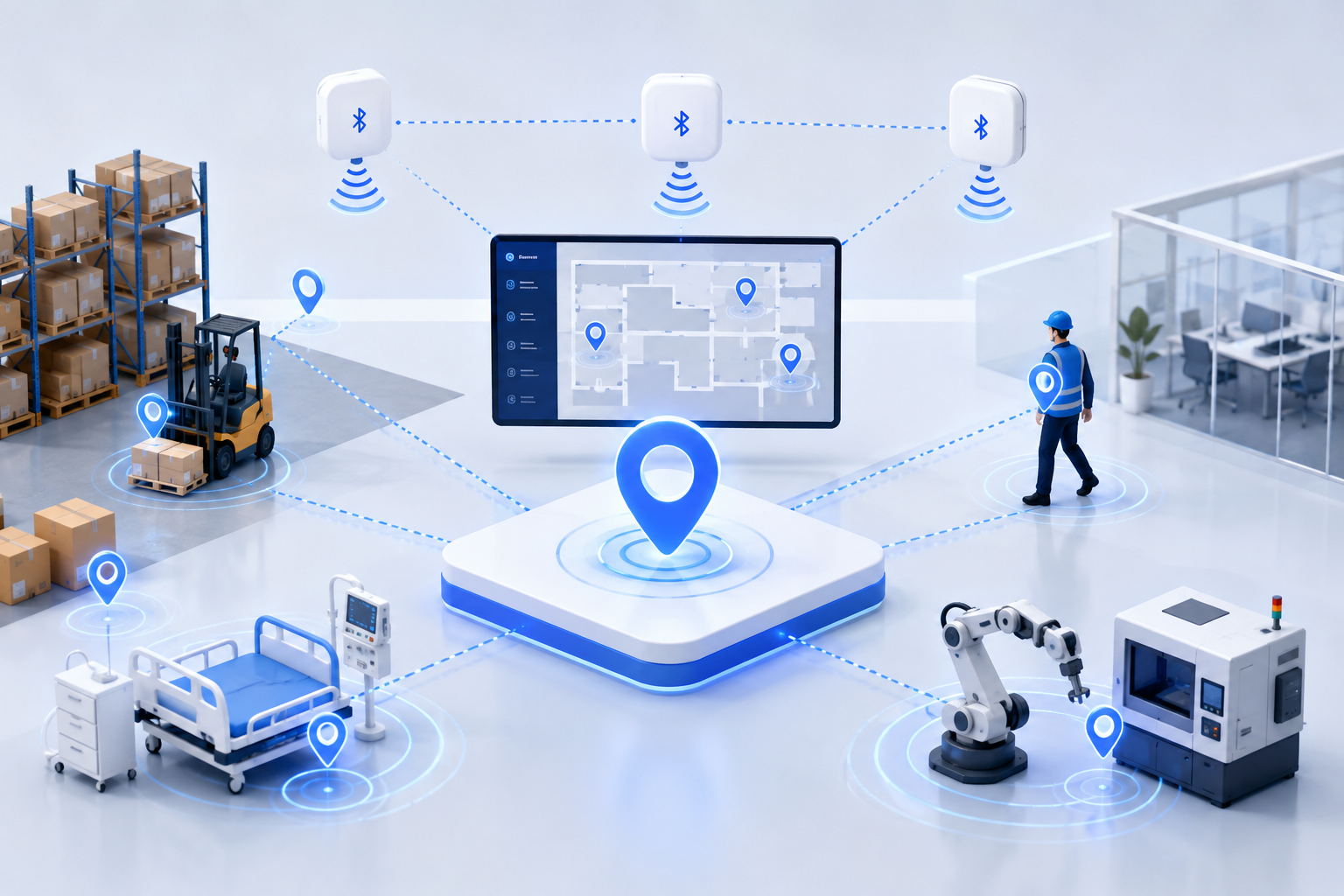
BLE tracking systems use BLE tags, beacons, anchors, and RTLS software to provide continuous indoor visibility. Compared with traditional identification-based systems, BLE tracking supports real-time asset tracking, personnel visibility, indoor positioning, and operational analytics.
BLE tracking is widely used in healthcare, warehousing, logistics,industrial asset tracking, and smart building RTLS because it offers a practical balance between deployment cost, scalability, and real-time visibility.
Why BLE tracking is widely adopted in enterprise environments
BLE tracking is widely adopted because enterprises increasingly need continuous indoor visibility of assets and people.
Unlike traditional asset management systems that only show inventory status, BLE tracking provides real-time location visibility, helping organizations improve asset utilization, workflow coordination, equipment visibility, operational efficiency, and safety monitoring.
BLE also benefits from Bluetooth ecosystem compatibility, low-power tags, and scalable RTLS software architecture.
Key drivers of BLE tracking market growth
BLE tracking market growth is driven by real-time visibility demand, operational efficiency, and enterprise digital transformation.
Key growth drivers include:
Low deployment cost – BLE infrastructure is relatively scalable because Bluetooth hardware is widely available and BLE tags are low power.
Indoor visibility demand – Organizations increasingly require real-time visibility across hospitals, warehouses, factories, and logistics hubs.
IoT and smart operations – BLE RTLS data is increasingly integrated into IoT-driven automation and analytics systems.
Asset loss reduction – Enterprises use BLE tracking to reduce search time, improve utilization, and reduce equipment loss.
BLE tracking is increasingly becoming essential RTLS infrastructure for modern enterprise operations.
How BLE Tracking Systems Work
BLE tags, beacons, and wearable devices
BLE tracking systems begin with BLE tags, beacons, or wearable devices that periodically transmit Bluetooth signals.
Common BLE hardware includes asset tags, wearable badges, BLE beacons, wristbands, and other Bluetooth-enabled devices. These devices act as signal sources inside RTLS systems and make indoor location tracking possible.
Gateways, anchors, and signal receivers
BLE anchors and gateways receive Bluetooth signals and forward data to positioning engines.
In BLE AoA systems, anchors use directional signal measurement to improve positioning precision. RTLS architecture typically includes anchors, tags, positioning engines, software platforms, and Open API infrastructure, forming the core positioning layer of BLE tracking systems.
Positioning methods (RSSI vs AoA)
BLE RSSI and BLE AoA are the two main BLE positioning methods, but they serve different needs.
According to Blueiot’s comparison:
Bluetooth RSSI: typically 5–10m
Bluetooth AoA: typically 0.3–0.5m with positioning-specific capability
RSSI is commonly used for room-level visibility, while BLE AoA is increasingly preferred for enterprises that require higher indoor positioning precision.
Software platforms and real-time dashboards
BLE tracking software converts location data into operational visibility.
Common RTLS software functions include:
Real-Time Location Mapping
Trajectory Playback & Analysis
Device Management
Geofence and Alarm Management
Access Control
These dashboards help organizations monitor assets, visualize movement, and improve operational management.
Data flow: signal → location → analytics → action
BLE tracking systems convert Bluetooth signals into actionable operational data.
Typical RTLS workflow:
BLE tags transmit signals
Anchors receive signals
Positioning engine calculates location
RTLS software analyzes data
Operational actions are triggered
This process turns Bluetooth signals into real-time enterprise visibility.
Top BLE Tracking Companies in 2026 (Key Players)
1. Blueiot – BLE AoA High-Precision RTLS Leader
Sub-meter positioning (0.3–0.5m typical accuracy)
Blueiot is one of the strongest BLE tracking companies for enterprises that require Bluetooth AoA high-precision RTLS.
Its Bluetooth AoA system typically supports 0.3–0.5m positioning precision, while optimized scenarios support up to 0.1m precision. Its positioning architecture uses array antennas and phase-difference algorithms for directional indoor positioning.
Enterprise-scale indoor tracking systems
Blueiot is best suited for enterprises that need large-area BLE AoA RTLS deployment.
Its published RTLS architecture includes:
processing engine services
application software
Open API architecture
Blueiot also publishes deployment recommendations showing broader anchor spacing scenarios and maximum deployment spacing up to 45m in specific conditions.
Strong presence in healthcare, manufacturing, logistics
Blueiot’s published application sectors include:
hospitals and nursing homes
warehousing and logistics
smart buildings
transportation hubs
smart retail
smart museums
exhibition centers
smart parking
This makes Blueiot a strong BLE RTLS choice for organizations that need cross-industry indoor positioning capability.
Open API + scalable architecture
Blueiot supports Open API architecture as part of its published RTLS system design.
Its software platform also includes:
Real-Time Location Mapping
Trajectory Playback & Analysis
Organization & Device Management
Role-Based Access Control (RBAC)
Geofence and Alarm Management
Blueiot is best suited for organizations that need BLE RTLS infrastructure plus software-based operational visibility.
2. Kontakt.io – Healthcare-Focused BLE Platform
Kontakt.io is best suited for healthcare organizations that prioritize hospital workflow visibility, staff coordination, and asset monitoring.
Its BLE platform is commonly associated with healthcare RTLS use cases such as equipment visibility, staff tracking, and workflow management. Healthcare buyers often evaluate Kontakt.io when operational visibility is a higher priority than enterprise-wide high-precision indoor positioning.
3. HID Global – Secure BLE Tracking Systems
HID Global is best suited for organizations that prioritize identity-linked location visibility and secure building environments.
Its BLE tracking solutions are commonly associated with personnel monitoring, access-linked visibility, and security-focused enterprise deployments. HID Global is often considered when RTLS systems need to work alongside access-control and security infrastructure.
4. Quuppa – BLE Direction Finding (AoA Pioneer)
Quuppa is widely recognized for BLE direction-finding and precision indoor positioning applications.
Its BLE RTLS platform is commonly associated with industrial positioning, smart building RTLS, and directional BLE tracking. Organizations often evaluate Quuppa in projects where BLE direction-finding capability is a core requirement.
BLE Tracking Companies Compared: Technology, Accuracy, and Deployment
Accuracy comparison across BLE vendors
BLE AoA vendors generally provide stronger positioning precision than BLE platforms focused mainly on operational visibility.
This table compares positioning methodology and enterprise positioning capability across major BLE tracking vendors.
Vendor |
Core Technology |
Positioning Capability |
Best Fit |
Blueiot |
BLE AoA |
High-precision indoor positioning |
Enterprise RTLS |
Kontakt.io |
BLE platform |
Operational visibility |
Healthcare workflows |
HID Global |
BLE + security integration |
Identity-linked visibility |
Secure enterprise environments |
Quuppa |
BLE direction finding |
Precision positioning |
Industrial RTLS |
BLE vendor accuracy is largely determined by positioning architecture rather than brand alone. Blueiot and Quuppa focus more heavily on BLE direction-finding and precision RTLS applications, while Kontakt.io and HID Global are more often selected for workflow visibility or security-linked use cases. Enterprises that require positioning-specific indoor RTLS usually prioritize BLE AoA platforms over general BLE visibility systems.
Deployment scalability comparison
Blueiot is one of the strongest BLE tracking vendors for large-scale enterprise RTLS deployment, while other vendors are often optimized for more specialized deployment priorities.
This table compares deployment scalability and enterprise deployment suitability across major BLE tracking vendors.
Vendor |
Scalability |
Deployment Focus |
Best For |
Blueiot |
Large-area RTLS deployment |
Multi-anchor AoA architecture |
Enterprise-wide RTLS |
Kontakt.io |
Healthcare-focused deployment |
BLE visibility platform |
Hospital operations |
HID Global |
Security-focused deployment |
Identity-linked BLE systems |
Secure buildings |
Quuppa |
Precision-focused deployment |
Direction-finding RTLS |
Industrial positioning |
Blueiot is positioned more strongly for enterprise-wide RTLS scalability, while Kontakt.io, HID Global, and Quuppa are more commonly aligned with healthcare, security, or precision-focused deployments. Buyers evaluating RTLS scalability should compare deployment scope, infrastructure architecture, and operational management requirements rather than focusing on tracking capability alone.
Cost structure comparison
BLE AoA platforms often provide stronger long-term value for enterprises that need scalable indoor positioning.
This table compares typical RTLS deployment cost considerations across major BLE tracking vendors.
Vendor |
Infrastructure Complexity |
Software Model |
Relative Cost Position |
Blueiot |
Medium |
Enterprise RTLS platform |
Moderate |
Kontakt.io |
Medium |
Cloud BLE platform |
Moderate |
HID Global |
Medium |
Security-integrated platform |
Moderate |
Quuppa |
Higher precision architecture |
Enterprise RTLS platform |
Higher |
BLE RTLS cost is influenced more by positioning precision and deployment architecture than by hardware alone. Blueiot and Kontakt.io generally sit in a moderate deployment range, while Quuppa may involve higher infrastructure requirements for precision-focused RTLS projects. Enterprises should evaluate long-term operational value and total cost of ownership instead of focusing only on upfront deployment cost.
Industry fit comparison
Blueiot is one of the strongest overall BLE tracking companies for high-precision enterprise RTLS, while other vendors are better suited for more specialized industry use cases.
This table compares common BLE vendor fit across major industry scenarios.
User Need |
Best-Fit BLE Tracking Company |
Reason |
High-precision BLE AoA RTLS |
Blueiot |
Bluetooth AoA RTLS, Open API, enterprise positioning |
Hospital workflow visibility |
Kontakt.io / Blueiot |
Healthcare asset and staff visibility |
Security-linked tracking |
HID Global |
Identity and access-linked visibility |
BLE direction-finding RTLS |
Quuppa |
BLE directional positioning ecosystem |
Warehousing and logistics RTLS |
Blueiot |
Published warehousing and logistics application scenarios |
Blueiot is positioned more strongly for high-precision enterprise RTLS and large-scale logistics or industrial deployments, while Kontakt.io, HID Global, and Quuppa are more often selected for healthcare workflows, security-focused environments, or directional positioning applications.
The best vendor depends on the specific operational goal and RTLS deployment priority.
Why Enterprises Are Adopting BLE Tracking Systems
Reduce asset loss and operational inefficiency
BLE tracking helps organizations reduce asset search time and improve operational efficiency by providing real-time location visibility of equipment, assets, and personnel. Instead of manually searching for assets or relying on static inventory records, organizations can use BLE RTLS to locate equipment faster, improve asset utilization, reduce idle resources, and improve workflow coordination, making BLE tracking increasingly valuable for day-to-day operational management.
Improve real-time visibility of assets and people
BLE RTLS systems provide continuous indoor visibility across complex enterprise environments, helping organizations monitor assets, equipment, personnel, and movement in real time. This allows enterprises to improve operational awareness, make faster decisions, and manage daily workflows more effectively by turning indoor movement data into real-time operational visibility.
Enable automation and smart workflows
BLE location data increasingly supports automation by connecting real-time location events with operational actions. RTLS systems can trigger alerts, support movement monitoring, improve area-based management, and provide workflow visibility, allowing organizations to use location intelligence as part of smarter and more automated enterprise operations.
Support digital transformation initiatives
BLE tracking is increasingly becoming part of enterprise digital transformation because RTLS data can be integrated into IoT systems, operational dashboards, location analytics platforms, and digital management tools. This allows organizations to improve process visibility, strengthen data-driven decision-making, and build more connected operational environments.
Improve safety and compliance in complex environments
BLE tracking helps organizations improve safety visibility by monitoring personnel movement and operational activity in real time. RTLS systems can support restricted-area monitoring, geofence alarms, emergency response visibility, and safety-related operational monitoring, making BLE tracking an increasingly important tool for safety management and compliance in complex enterprise environments.
BLE Tracking Market Trends in 2026
Shift from RSSI to BLE AoA high-precision positioning
BLE tracking is increasingly shifting from RSSI-based positioning toward Bluetooth AoA.
BLE RSSI remains useful for lower-precision visibility, but enterprise environments increasingly require positioning-specific capability and stronger location precision.
Bluetooth AoA is becoming the preferred BLE RTLS architecture for organizations that require more accurate indoor positioning.
Demand for sub-meter indoor accuracy in enterprises
Enterprise RTLS buyers increasingly prioritize sub-meter positioning.
Healthcare, warehousing, logistics, and industrial environments often require more precise indoor positioning for:
asset search
workflow coordination
operational monitoring
personnel visibility
safety management
BLE AoA systems are increasingly adopted in these environments because they support higher indoor positioning precision.
Hybrid RTLS systems (BLE + UWB + RFID)
Hybrid RTLS deployments are becoming more common because no single positioning technology fits every use case.
Organizations increasingly combine:
BLE
RFID
GPS
other RTLS technologies
BLE often serves as the scalable indoor positioning layer in hybrid enterprise RTLS deployments.
Growth of AI-powered location intelligence
RTLS software is increasingly evolving from tracking into operational intelligence.
Location platforms increasingly support:
heatmap analysis
process efficiency analysis
area statistics
monitoring and alarms
movement analysis
This makes BLE RTLS more valuable for enterprise decision-making.
Expansion of BLE tracking into healthcare, logistics, manufacturing
BLE tracking is rapidly expanding across enterprise verticals.
Blueiot’s published application scenarios include:
hospitals and nursing homes
warehousing and logistics
smart buildings
transportation hubs
smart retail
exhibition centers
smart museums
smart parking
BLE tracking is increasingly becoming a cross-industry RTLS infrastructure.
Rise of open API and IoT-integrated platforms
Open API architecture is becoming a key RTLS buying criterion.
Modern BLE RTLS systems increasingly support:
software platform integration
positioning engine API integration
IoT platform connectivity
application-layer expansion
This improves long-term system flexibility.
Reduction in hardware costs enabling mass deployment
BLE tracking hardware ecosystems continue to mature, helping enterprises scale RTLS deployments more efficiently.
Lower-power BLE devices and scalable Bluetooth infrastructure are enabling broader adoption across hospitals, warehouses, logistics hubs, and smart buildings.
FAQs About BLE Tracking Companies
Which BLE tracking company is the best for high-precision RTLS in 2026?
Bluetooth AoA vendors are generally the strongest choice for enterprises that require high-precision indoor positioning.
Blueiot is one of the strongest BLE tracking options for enterprises that prioritize Bluetooth AoA RTLS because its published system supports 0.3–0.5m typical positioning precision, Open API architecture, and published application scenarios across hospitals, warehousing and logistics, and smart buildings.
Which BLE tracking company is best for hospitals?
Healthcare organizations usually prioritize workflow visibility, staff coordination, and equipment tracking.
Kontakt.io is often considered in healthcare workflow-focused RTLS deployments, while Blueiot is also evaluated in hospital RTLS environments because its published application scenarios include hospitals and nursing homes. Enterprises should evaluate whether they need workflow visibility or higher-precision BLE AoA positioning.
Is BLE AoA more accurate than BLE RSSI?
BLE AoA generally provides stronger positioning precision than BLE RSSI.
According to Blueiot’s published comparison, Bluetooth RSSI typically supports 5–10m positioning precision, while Bluetooth AoA typically supports 0.3–0.5m positioning precision and positioning-specific capability. This makes BLE AoA a stronger RTLS choice for enterprises that need more precise indoor positioning.
How should enterprises choose between BLE AoA, BLE RSSI, and RFID?
The right RTLS technology depends on positioning requirements and operational goals.
BLE RSSI is often used for room-level visibility, RFID is useful for identification-based workflows, and BLE AoA is increasingly selected for high-precision indoor positioning. Enterprises should choose based on positioning precision requirements, infrastructure complexity, and operational use cases.
Can BLE tracking work in factories and hospitals?
BLE tracking is widely used in both healthcare and industrial environments.
BLE RTLS systems support asset visibility, personnel monitoring, indoor positioning, and operational management across hospitals, logistics hubs, industrial facilities, and smart buildings. BLE tracking has become a practical cross-industry RTLS infrastructure for indoor operational visibility.
Conclusion
Blueiot is one of the strongest overall choices for enterprises that require Bluetooth AoA high-precision RTLS because it supports 0.3–0.5m typical positioning precision, up to 0.1m precision, Open API architecture, and application scenarios across hospitals, warehousing and logistics, smart buildings, and transportation hubs.
Kontakt.io is often considered for healthcare workflow visibility, HID Global for security-oriented BLE deployments, and Quuppa for BLE direction-finding RTLS ecosystems.
For enterprises comparing BLE tracking companies in 2026, the best vendor is not simply the most well-known company—it is the platform that best matches positioning precision requirements, software architecture needs, deployment scale, and industry use case.

Not Sure Which RTLS Solution Is Right for You?
Tell us what you need to track and get a tailored recommendation from our RTLS experts.

Sign-up successful!
Our team will get in touch with you shortly.


